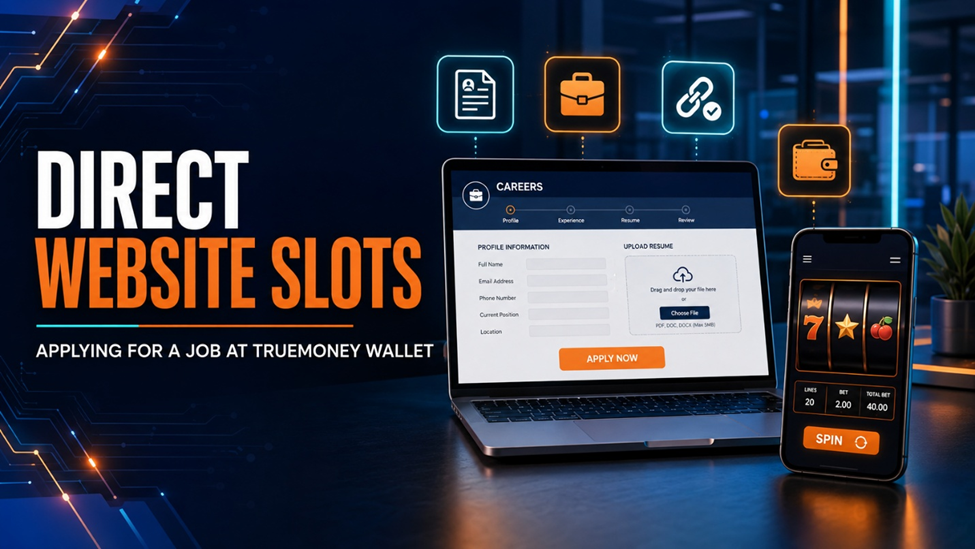
Digital wallets, online gaming platforms, and financial technology companies operate in closely connected parts of the digital economy. Electronic wallets can process payments, technology teams can maintain secure financial systems, and gaming websites may allow eligible adults to use approved payment methods. Despite this connection, using a wallet for online gaming and seeking employment with a wallet company are entirely separate activities.
Anyone researching สล็อตเว็ปตรง, Real-money slots; applying for a job at TrueMoney Wallet should understand these differences. Playing an online game does not create an employment opportunity, and applying for a legitimate position should never require gambling, depositing money, or sharing wallet security credentials.
This guide explains the general features of direct slot websites, the responsibilities involved in real-money gaming, and the safer process for applying for a job at a financial-technology company such as TrueMoney. It also covers common recruitment scams, account-security practices, and important questions candidates and players should ask before taking action.
Understanding Direct Website Slots
Direct Website Slots are online slot games accessed through a gaming platform’s main web address. Users can typically open the website through a browser, create an account where permitted, and enter the game lobby without relying on an unrelated intermediary.
A direct website may provide:
- Browser-based slot games
- Mobile and desktop access
- User registration
- Demo games
- Real-money games
- Deposit and withdrawal services
- Promotions and bonuses
- Customer support
- Responsible gaming tools
The word “direct” does not automatically prove that a platform is secure, licensed, or trustworthy. Any website can describe itself as direct. Users must still confirm the operator, license, terms, payment policies, game providers, and account-protection measures.
What Are Real-Money Slots?
Real-money slots are digital slot games where players wager funds with actual monetary value. Unlike demo games, each paid round can increase or decrease the withdrawable account balance.
These games may include:
- Classic three-reel slots
- Five-reel video slots
- Cascading games
- Cluster-pay games
- Ways-to-win slots
- Jackpot games
- Free-spin features
- Multipliers and bonus rounds
Every spin involves uncertainty. A visually engaging game, popular software provider, or convenient wallet does not guarantee a winning outcome. Players can lose some or all of the money deposited.
Real-money gaming should be treated only as paid entertainment. It should never be considered employment, an investment, a salary-generating system, or a reliable way to earn income.
The Difference Between Gaming and Employment
The title Direct Website Slots: Applying for a Job at TrueMoney Wallet combines two subjects that must remain clearly separated.
Using a digital wallet on a gaming website means using a financial service to complete a transaction where supported and legally permitted. Applying for a job means submitting professional information to an employer for consideration for a genuine vacancy.
The main differences include:
| Activity | Online Slot Gaming | Employment Application |
| Main purpose | Paid entertainment | Seeking professional work |
| Money flow | Player may deposit and lose money | Legitimate employer pays the employee |
| Required information | Gaming account and payment details | CV, qualifications and work history |
| Outcome | Determined by game mechanics and chance | Determined by recruitment assessment |
| Financial expectation | No guaranteed return | Salary under an employment agreement |
| Appropriate channel | Licensed gaming platform | Official company career channel |
A recruitment process should not require an applicant to play Slots, place bets, create gambling accounts, or demonstrate wallet transactions with personal money.
What Is TrueMoney Wallet?
TrueMoney Wallet is commonly understood as a digital-wallet service available in supported markets. Electronic wallets generally allow eligible users to make payments, receive certain transfers, purchase supported services, or manage funds from a mobile interface.
Exact features can vary by country, account status, regulations, and current company policy. Before using any service, users should review the official information provided for their location.
A digital wallet may be accepted by various merchants or online platforms, but acceptance does not mean the wallet company owns, operates, or endorses every website where its payment method appears.
This distinction is particularly important with Real-money slots. A gaming platform displaying a wallet logo does not automatically prove an official partnership. Users should verify payment support through legitimate platform information and applicable wallet policies.
Employment Opportunities in a Digital-Wallet Company
Financial-technology companies require employees with different professional backgrounds. Available roles depend on the organization, location, current vacancies, and operational needs.
Possible departments may include:
- Software engineering
- Mobile application development
- Cybersecurity
- Fraud prevention
- Regulatory compliance
- Risk management
- Customer support
- Finance and accounting
- Product management
- Business development
- Marketing
- Human resources
- Data analysis
- Quality assurance
- Operations
Applicants should focus on roles that match their education, experience, technical skills, language ability, and legal right to work in the relevant location.
A genuine vacancy should include a job description, responsibilities, required qualifications, employment location, and a formal application process.
Preparing Before Applying for a Job
A strong application begins before the candidate submits a CV. The applicant should review the role carefully and determine whether their qualifications match the essential requirements.
Preparation may include:
- Reading the full job description
- Researching the company’s products and services
- Identifying relevant skills
- Updating the CV
- Preparing a professional cover letter
- Organizing certificates or portfolio materials
- Checking contact information
- Reviewing the application for errors
Candidates should avoid using the same generic CV for every role. A targeted application makes it easier for recruiters to understand why the candidate is suitable.
Creating a Professional CV
A CV should present relevant professional information clearly. It does not need excessive design or unnecessary personal details.
A practical structure includes:
Contact Information
Include a professional name, current city, phone number, and appropriate email address. Do not include wallet passwords, PINs, OTPs, or unrelated financial details.
Professional Summary
Write a short description of experience, strengths, and career focus. The summary should connect naturally to the position.
Work Experience
List previous roles in reverse chronological order. For each position, include the employer, job title, dates, and measurable responsibilities or achievements.
Education
Include relevant degrees, diplomas, training programs, and professional certifications.
Technical and Professional Skills
Mention skills related to the vacancy, such as data analysis, customer service, compliance procedures, software development, fraud detection, or digital marketing.
Languages
List languages and realistic proficiency levels when relevant to the role.
A CV should be truthful. False qualifications may result in rejection or termination if discovered later.
Writing a Focused Cover Letter
A cover letter should explain why the candidate is interested in the specific position and how their experience addresses the employer’s needs.
A clear cover letter generally includes:
- The position being applied for
- A short introduction
- Relevant experience
- One or two strong examples
- Interest in the company’s work
- A professional closing
The candidate should avoid exaggerated claims and unrelated information. Discussing personal results from Slots would generally be irrelevant to a financial-technology job unless the vacancy specifically concerns regulated gaming-payment compliance and the experience is professional rather than personal.
Using Official Application Channels
When applying for a job at TrueMoney Wallet or another financial-technology company, candidates should use an official career page, verified professional profile, or clearly authorized recruitment portal.
Before submitting personal information, check:
- Whether the web address is correct
- Whether the vacancy appears legitimate
- Whether the recruiter uses an appropriate company identity
- Whether the job description is detailed
- Whether the company requests reasonable information
- Whether communication is professional
- Whether the interview process makes sense
Avoid sending identity documents through unverified messaging accounts. Sensitive documents should be provided only when necessary and through an approved secure process.
Recruitment Scams to Avoid
Well-known company names can be used in fraudulent job offers. Scammers may create fake websites, social-media profiles, messaging accounts, or appointment letters.
Warning signs include:
- A guaranteed job without an interview
- A request to pay an application fee
- A demand to deposit into a gaming website
- A request to open multiple wallet accounts
- A promise of payment for processing transfers
- Requests for an OTP, PIN, or password
- Pressure to respond immediately
- An offer with unrealistic salary claims
- Poorly written or inconsistent documents
- Communication only through a personal account
- A request to receive and forward money
- A demand to purchase equipment from a specific unknown seller
A legitimate employer may request identity and banking information at an appropriate stage after verification or hiring. However, it should never request a wallet password or one-time authorization code.
Why Applicants Should Never Pay for a Job
A legitimate employer pays employees for their work. Applicants should not need to fund an account, buy virtual items, place bets, or send a security deposit to obtain a standard job.
Fraudulent recruiters sometimes describe payments as:
- Registration fees
- Processing fees
- Interview deposits
- Training fees
- Security payments
- Account activation charges
- Document-verification fees
- Refundable employment deposits
Such requests deserve serious caution. Candidates should independently confirm the vacancy through the company’s official contact information before transferring any money.
The topic of Real-money slots; applying for a job at TrueMoney Wallet should never be presented as a combined earning program. Slot gaming is not a recruitment test or employment requirement.
Protecting Personal Information During Recruitment
Employment applications can contain sensitive information. Candidates should limit what they share during early stages.
A first application may require:
- Full name
- Contact information
- CV
- Work history
- Education
- Portfolio or professional profile
It should not normally require:
- A wallet password
- A mobile banking PIN
- A one-time verification code
- Complete card security details
- Unrestricted account access
- Payment to a personal wallet
Identity documents may be required later for legitimate hiring, work authorization, or background checks. Candidates should confirm the recipient and purpose before providing them.
Preparing for a Fintech Interview
A digital-wallet company may assess technical knowledge, customer awareness, problem-solving ability, security judgment, or regulatory understanding.
Candidates can prepare by reviewing:
- The job description
- Digital-wallet fundamentals
- Mobile payment processes
- Account security
- Fraud prevention
- Customer-support principles
- Data privacy
- Relevant technical tools
- Examples from previous work
- The company’s official products
Interview answers should be specific. Candidates can use examples that explain the situation, their responsibility, the action they took, and the result.
Possible Interview Questions
Questions vary by role, but common examples may include:
- Why are you interested in financial technology?
- What do you understand about digital wallets?
- How would you protect sensitive customer information?
- How would you handle a disputed transaction?
- Describe a difficult customer-service situation.
- How do you identify suspicious account activity?
- How do you prioritize multiple urgent tasks?
- What experience do you have with mobile products?
- How would you explain a failed payment to a customer?
- Why are you suitable for this role?
Technical candidates may face coding, system-design, data, or security assessments. Compliance candidates may be tested on customer verification, transaction monitoring, and risk controls.
Skills Relevant to Wallet-Based Businesses
The most valuable skills depend on the position.
Customer Support Skills
Support employees need clear communication, patience, policy knowledge, privacy awareness, and the ability to investigate transaction problems.
Technical Skills
Engineering roles may require programming, database management, application security, API development, cloud systems, testing, or mobile development.
Compliance Skills
Compliance teams may work with identity verification, anti-fraud controls, transaction monitoring, recordkeeping, and regulatory processes.
Analytical Skills
Data professionals may examine transaction patterns, product performance, customer behavior, operational efficiency, and fraud indicators.
Product Skills
Product managers coordinate customer needs, business objectives, technical development, design, testing, and product improvement.
Candidates should provide evidence of relevant skills rather than listing broad terms without examples.
Understanding Payment Security
Whether someone is applying for a job or using Direct Website Slots, digital payment security is important.
Basic protections include:
- Strong and unique passwords
- Two-step verification
- Secure mobile devices
- Updated applications
- Private internet connections
- Careful review of transaction details
- Protection of one-time codes
- Immediate reporting of unknown activity
Users should never allow another person to remotely control a device containing wallet or banking applications.
Evaluating Direct Website Slots
Eligible adults considering online gaming should evaluate the platform independently from any job-related information.
Important factors include:
Operator Transparency
The website should identify the company responsible for the gaming service and provide appropriate contact details.
Licensing
Where required, licensing information should be independently verifiable.
Secure Access
The website should use an encrypted connection and offer suitable account-protection options.
Authentic Games
The game provider, rules, paytable, RTP, betting limits, and bonus mechanics should be accessible.
Payment Terms
Deposit limits, withdrawal limits, fees, processing times, and verification requirements should be published.
Customer Support
Support should answer specific questions and provide written records for payment investigations.
Responsible Gaming
The account should offer controls such as deposit limits, cooling-off periods, and self-exclusion.
A wallet logo, promotional banner, or job advertisement cannot replace these checks.
How Deposits Usually Work
A deposit into a gaming account generally begins in the official cashier.
The player typically:
- Signs in to the verified platform
- Opens the deposit section
- Selects an available payment method
- Reviews limits and fees
- Enters an amount
- Confirms the transaction
- Saves the payment reference
- Checks the gaming balance
Players should avoid transfers based on instructions received from unknown social-media accounts. Payment information should be confirmed through the official platform.
How Withdrawals Usually Work
A withdrawal request may require the player to choose an approved payment method, enter the amount, and complete identity or account-security checks.
Processing may be affected by:
- Account verification
- Payment ownership
- Bonus requirements
- Withdrawal limits
- Security screening
- Operator approval
- Payment-provider processing
The platform should explain these requirements before accepting deposits. Repeated demands for additional deposits before releasing a withdrawal are a serious warning sign.
Understanding RTP
RTP means Return to Player. It is a theoretical percentage describing how much of the total amount wagered may be returned across a large number of rounds.
For example, a game with a theoretical RTP of 96% is designed to return an average of 96 units from every 100 units wagered over its complete mathematical cycle.
It does not mean every user will receive 96% of a deposit. Short sessions can produce very different results.
RTP:
- Applies over a large number of rounds
- Does not predict the next spin
- Is not a guaranteed personal return
- May differ between game versions
- Does not remove the house advantage
Real-money slots always involve the possibility of financial loss.
Understanding Volatility
Volatility describes the general payout pattern of a slot.
Low Volatility
Low-volatility games tend to provide smaller rewards more frequently.
Medium Volatility
Medium-volatility games generally balance reward frequency and possible size.
High Volatility
High-volatility games may produce rewards less frequently while offering the possibility of larger individual payouts.
Volatility does not indicate when a win will occur. It helps players understand how sharply a balance may move.
Demo Games Versus Real-Money Slots
Demo games use virtual credits. They allow users to examine the controls, rules, symbols, and bonus features without placing a real-money wager.
Real-money slots use deposited funds or an eligible cash balance. Losses have genuine financial consequences, and winnings may be subject to withdrawal rules.
Demo success cannot predict real-money results. Virtual wins are generally not withdrawable, and a successful demo session does not guarantee that the same pattern will appear later.
Slot Bonuses and Wagering Requirements
Gaming platforms may advertise deposit bonuses, free spins, cashback, or membership rewards. These offers can include conditions that affect withdrawals.
Players should review:
- Minimum deposit
- Wagering requirement
- Eligible games
- Maximum bet
- Expiration period
- Maximum winnings
- Restricted payment methods
- Withdrawal limits
For example, a 100-unit bonus with a 30-times wagering requirement may require 3,000 units in qualifying bets.
A large promotional number is not automatically valuable. The complete terms determine whether the bonus is suitable.
Responsible Bankroll Management
A bankroll is money reserved solely for gaming entertainment. It should never include funds needed for essential responsibilities.
A responsible plan defines:
- Maximum deposit
- Session budget
- Maximum bet
- Loss limit
- Time limit
- No borrowing
- No loss chasing
Money intended for housing, food, healthcare, education, transportation, debt repayment, or family support should never be used for Real-money slots.
No betting system can guarantee a profit.
Keeping Employment and Gaming Funds Separate
A job seeker may need money for transportation, communication, professional clothing, document preparation, or relocation. These funds should remain separate from gambling money.
Candidates should never use essential job-search funds for Slots in the hope of generating application expenses. Real-money gaming is unpredictable and can make financial pressure worse.
A useful financial structure can include:
- Essential living funds
- Emergency savings
- Job-search expenses
- Optional entertainment funds
Only genuinely disposable entertainment money should ever be considered for gaming, where legally permitted.
Avoiding False “Play-to-Work” Offers
A fraudulent scheme may claim that users can obtain a job by completing gaming tasks, making deposits, increasing account activity, or recruiting other players.
Warning signs include statements such as:
- Play these games to activate your employment.
- Deposit first to receive a work account.
- Complete slot tasks to unlock your salary.
- Use personal funds to test payment systems.
- Recruit players to qualify for a permanent position.
- Pay a refundable wallet-security deposit.
These are not normal recruitment practices. Applicants should stop communication and verify the vacancy independently.
Distinguishing Genuine Work From Money-Movement Scams
Some scams describe a role as a payment assistant, wallet agent, transaction tester, or account operator. The supposed employee is asked to receive money and forward it elsewhere.
This can expose the person to financial loss, account suspension, identity theft, or legal problems.
A legitimate role should include:
- A verified employer
- A clear job description
- Formal recruitment
- Defined responsibilities
- A written employment agreement
- Lawful salary arrangements
- Appropriate company systems
Employees should not be expected to use personal wallet accounts to route unexplained customer funds.
Reviewing an Employment Offer
Before accepting a job, candidates should examine the offer carefully.
A legitimate offer should usually identify:
- Employer name
- Job title
- Work location
- Responsibilities
- Start date
- Salary or compensation structure
- Working hours
- Benefits where applicable
- Reporting manager
- Employment conditions
The candidate should confirm the offer using official company contact information. A PDF containing a logo and signature can still be fraudulent.
Questions to Ask a Recruiter
Candidates can ask:
- Where is the official vacancy published?
- What is the full legal name of the employer?
- Who will conduct the interview?
- Where is the job based?
- What are the main responsibilities?
- What is the hiring timeline?
- Which documents are required and why?
- Will communication continue through an official channel?
- Is any payment required?
A request for an application payment should be treated with caution and independently verified.
Frequently Asked Questions
Does Playing Direct Website Slots Help Someone Get a TrueMoney Job?
No. Gaming activity does not create a legitimate employment advantage. A genuine application should be evaluated through qualifications, experience, assessments, and interviews.
Should an Applicant Deposit Money as Part of Recruitment?
A standard job application should not require a gaming deposit, wallet activation payment, or refundable employment fee.
Can a Recruiter Ask for an OTP?
No genuine recruiter needs a wallet or banking OTP. Sharing one can authorize an unwanted transaction or account change.
Does the Appearance of a Wallet Logo Prove a Partnership?
No. A logo can be copied. Any claimed relationship should be confirmed through official information.
Are Real-Money Slots a Form of Employment?
No. Real-money slots are gambling entertainment involving financial risk. They do not provide a salary or guaranteed income.
Can Slot Winnings Fund a Job Search?
Winnings are never guaranteed. Essential job-search expenses should not depend on unpredictable gambling outcomes.
Final Thoughts
Direct Website Slots and employment applications belong to two different areas. Direct slot platforms provide eligible adults with access to gaming entertainment, while applying for a job at a digital-wallet company is a professional recruitment process based on qualifications and organizational needs.
The phrase สล็อต ที่ ได้ เงิน จริง สมัคร งาน ท รู มัน นี้ วอ ล เล็ ท should not be interpreted as a combined earning opportunity. A legitimate employer should never require applicants to gamble, deposit money into a slot website, reveal an OTP, or use a personal wallet to route unexplained funds.
Candidates should apply through verified channels, prepare a focused CV, protect personal information, and confirm every offer independently. Players who choose to use Direct Website Slots should separately verify the gaming operator, read payment and bonus terms, use only affordable entertainment funds, and maintain strict limits.
Clear separation is the safest approach: employment should offer lawful compensation for genuine work, while Real-money slots must be recognized as uncertain entertainment that can result in financial loss.